AI vs Machine Learning vs Deep Learning Explained
Discover the exact differences between AI, machine learning, and deep learning. Understand how these technologies work and their unique applications.
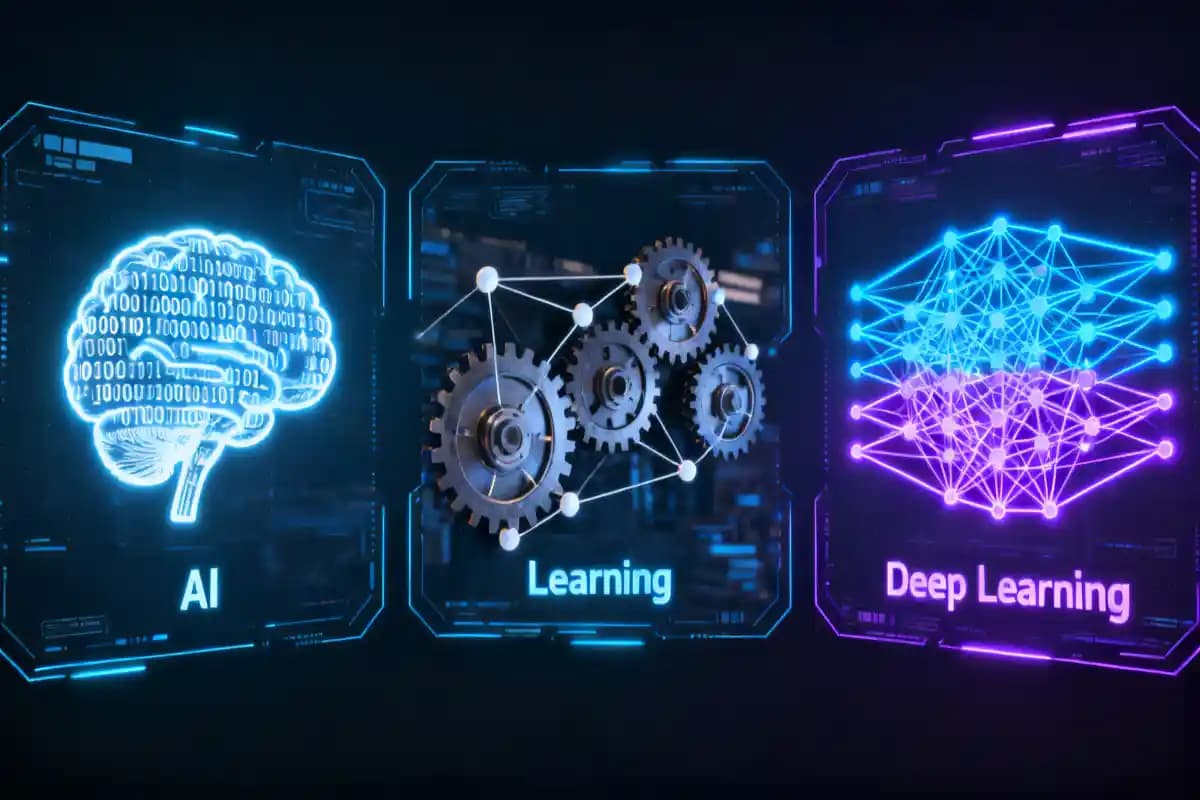
The technology landscape changes rapidly every single day. People constantly hear terms like artificial intelligence, machine learning, and deep learning. Industry leaders often use these buzzwords interchangeably. However, they are not the same thing. They represent different layers of technological advancement. Therefore, understanding the distinction is crucial for modern professionals.
This comprehensive guide will break down these concepts. We will explore their unique characteristics in detail. Furthermore, we will look at how they connect. You will learn how they shape our digital world.
The Broad Umbrella: Artificial Intelligence
Artificial Intelligence is the broadest concept here. We simply call it AI. It refers to the simulation of human intelligence. Machines are programmed to think like humans. They mimic human actions and problem-solving skills.
The primary goal of AI is creating smart machines. These machines should perform tasks requiring human intellect. For example, AI can understand spoken language. It can also recognize visual patterns easily. Moreover, it can make complex decisions.
The History of AI
The concept of AI is surprisingly old. It dates back to the mid-20th century. Alan Turing proposed the famous Turing Test. This test measures a machine's ability to exhibit intelligent behavior. Soon after, scientists began writing basic AI programs.
Early AI relied heavily on strict rules. Programmers hard-coded logical if-then statements. This approach is called symbolic AI. It worked well for simple, well-defined problems. For instance, early computers could play chess using symbolic AI. However, this method had severe limitations. It could not handle complex, ambiguous real-world situations.
For a deeper historical perspective, the Stanford AI Index provides excellent academic insights.
Types of Artificial Intelligence
AI is generally categorized into three main types.
First, we have Artificial Narrow Intelligence. We also call this Weak AI. This is the only type of AI existing today. Narrow AI is trained for one specific task. It cannot operate outside its predefined scope. Voice assistants like Siri are prime examples.
Second, we have Artificial General Intelligence. This is also known as Strong AI. This type of AI remains purely theoretical. General AI would possess human-level cognitive abilities. It could understand and learn any intellectual task. Organizations like Microsoft explore these vast possibilities in their AI overview.
Third, there is Artificial Superintelligence. This represents a future where machines surpass human intelligence. They would excel in creativity, wisdom, and problem-solving. This concept currently belongs strictly to science fiction.
Real-World AI Applications
AI is everywhere in our daily lives.
Customer Service: Chatbots handle customer queries instantly. They use basic natural language processing.
Navigation: Maps use AI to analyze traffic speed. Therefore, they can find the fastest route.
Healthcare: AI schedules patient appointments efficiently. It also manages hospital resources effectively.
AI implementation requires a solid strategy. Developers can learn modern methods in this [suspicious link removed].
The Engine of AI: Machine Learning
Machine learning is a specific subset of AI. We commonly refer to it as ML. It focuses on the use of data and algorithms. The goal is imitating how humans learn. Crucially, ML improves its accuracy over time.
IBM provides a very detailed definition of machine learning. In simple terms, you do not explicitly program the machine. Instead, you feed it massive amounts of data. The algorithm then finds patterns within that data.
How Machine Learning Works
Traditional programming requires giving the computer strict rules. The computer applies these rules to data to get answers. Machine learning flips this entirely. You give the computer data and the final answers. The computer then figures out the rules itself.
This process requires feature engineering. Human experts must manually extract relevant features from raw data. They must structure the data for the algorithm. For example, to identify a car, a human labels the wheels. This manual step takes significant time and effort.
Categories of Machine Learning
Machine learning algorithms fall into three primary categories.
Supervised Learning
This is the most common type of ML. The algorithm trains on a labeled dataset. This means the data includes the correct answers. The model learns to map inputs to the correct outputs.
For example, you show the model thousands of cat pictures. Every picture is labeled "cat." Eventually, it recognizes new cat pictures. Common supervised algorithms include linear regression and decision trees.
Unsupervised Learning
Unsupervised learning uses completely unlabeled data. The system must discover hidden patterns on its own. There are no correct answers provided beforehand.
The algorithm groups data based on similarities. This process is called clustering. Retailers use this to segment their customers. They find distinct buyer groups without prior labels.
Reinforcement Learning
This type of learning is fascinating. It relies on a reward and punishment system. An agent interacts with an environment. It takes actions to achieve a goal.
If the action is good, it receives a reward. If the action is bad, it receives a penalty. The agent learns to maximize total rewards. This is how machines learn to play complex video games.
Real-World Machine Learning Applications
Machine learning drives many enterprise operations today.
Recommendation Systems: Streaming platforms suggest movies using ML. They analyze your past viewing history.
Fraud Detection: Banks use ML to monitor credit cards. The system flags unusual spending patterns instantly.
Email Filtering: Email providers use ML algorithms. They successfully classify incoming messages as spam or legitimate.
Businesses increasingly rely on these automated systems. You can explore how these workflows operate by studying [suspicious link removed].
The Deepest Layer: Deep Learning
Deep learning is a specialized subset of machine learning. It is the most advanced technology discussed here. Deep learning relies on artificial neural networks. These networks are inspired by the human brain.
Google Cloud offers great educational resources on the broader nature of AI, which includes deep learning. Deep learning fundamentally changes how machines process data.
The Architecture of Deep Learning
Deep learning uses multiple layers of algorithms. These layers form a neural network. A typical network has three main parts.
First is the input layer. This layer receives the raw data. Second are the hidden layers. A "deep" network has many hidden layers. These layers perform complex mathematical computations. Third is the output layer. This layer delivers the final prediction or decision.
IBM explains the technical intricacies of deep learning through the lens of these complex neural layers.
Eliminating Feature Engineering
Deep learning has one massive advantage over traditional ML. It eliminates the need for manual feature engineering.
In traditional ML, humans must label data features. Deep learning algorithms do this automatically. They learn high-level features directly from raw data. For instance, a deep learning model analyzes a face. The first layer detects edges. The next layer detects shapes. The final layers identify the actual face. No human intervention is needed for this feature extraction.
Types of Deep Learning Networks
Different neural networks solve different types of problems.
Convolutional Neural Networks (CNNs)
CNNs are exceptional at processing grid-like data. Images are the most common example. CNNs power facial recognition systems. They are also crucial for medical image analysis. They scan X-rays to detect anomalies accurately.
Recurrent Neural Networks (RNNs)
RNNs excel with sequential data. They have an internal memory. Therefore, they remember previous inputs. This makes them perfect for language translation. They also power speech recognition systems. When you talk to your phone, RNNs process the audio.
Generative Adversarial Networks (GANs)
GANs consist of two competing neural networks. One generates fake data. The other tries to detect the fakes. They train against each other continuously. This results in highly realistic synthetic data. They can generate human faces that do not exist.
Generative AI heavily utilizes deep learning. To understand this better, read this generative AI beginner guide.
Hardware Requirements for Deep Learning
Deep learning requires massive computational power. Traditional computer processors are usually not enough.
These networks perform millions of matrix multiplications simultaneously. Therefore, they require Graphics Processing Units. GPUs handle parallel processing exceptionally well. Without powerful GPUs, training takes months. Modern deep learning relies entirely on specialized hardware.
If you want to understand hardware metrics better, check out this guide on [suspicious link removed].
Real-World Deep Learning Applications
Deep learning solves the most complex technological challenges.
Autonomous Vehicles: Self-driving cars rely entirely on deep learning. They must process real-time visual data constantly. For more context, read about [suspicious link removed].
Medical Research: Deep learning discovers new pharmaceutical drugs. It analyzes complex biological data faster than humans.
Virtual Assistants: Advanced assistants use deep learning. They understand context and nuance in human speech.
Comparing AI vs Machine Learning vs Deep Learning
Understanding the core differences requires direct comparison. They differ in data needs, hardware, and autonomy.
1. Scope and Definition
AI is the overarching category. It encompasses any technique enabling machines to mimic human behavior.
Machine learning is a subset of AI. It gives machines the ability to learn without explicit programming.
Deep learning is a subset of machine learning. It uses artificial neural networks to solve highly complex problems.
2. Data Dependency
AI systems can run on relatively little data. Simple rule-based AI does not need large datasets.
Machine learning requires significant amounts of data. The more data it processes, the better it performs. However, its performance eventually plateaus.
Deep learning requires massive, colossal amounts of data. Unlike traditional ML, deep learning scales infinitely. More data constantly leads to better performance. Without huge datasets, deep learning models fail.
3. Hardware Dependencies
Basic AI operates perfectly on standard computer processors.
Traditional machine learning also runs on standard CPUs. It rarely requires specialized, expensive hardware setups.
Deep learning is entirely different. It absolutely requires high-end GPUs. The mathematical computations are far too heavy for standard CPUs. Therefore, deep learning is highly resource-intensive.
4. Feature Engineering
This is the most critical technical difference.
Machine learning requires manual human intervention. Data scientists must manually extract features from the data. They tell the algorithm what variables to examine.
Deep learning automates feature engineering completely. The neural network discovers relevant features on its own. It processes raw data directly. This saves massive amounts of human labor.
5. Execution Time
Machine learning models train very quickly. Training might take a few minutes or hours. However, predicting outcomes can sometimes take longer.
Deep learning models take a very long time to train. Training a complex model can take several weeks. However, once trained, their prediction time is incredibly fast. They process new inputs in milliseconds.
6. Interpretability
Interpretability means understanding how a model makes decisions.
Machine learning models are usually highly interpretable. For example, you can easily trace a decision tree. You know exactly why the algorithm made a specific choice.
Deep learning models are "black boxes." They are extremely difficult to interpret. The hidden layers perform invisible calculations. Even the engineers who built them cannot always explain specific decisions. This creates challenges in highly regulated industries like finance.
Summary Comparison Table
Here is a quick visual breakdown of the three technologies. This table summarizes their fundamental differences.
Feature | Artificial Intelligence (AI) | Machine Learning (ML) | Deep Learning (DL) |
Definition | Simulating human intelligence. | Algorithms learning from data. | Neural networks learning from vast data. |
Scope | Broadest concept. | Subset of AI. | Subset of Machine Learning. |
Human Intervention | High (for rule-based systems). | Medium (needs feature engineering). | Low (automates feature engineering). |
Data Required | Varies widely. | Thousands of data points. | Millions of data points. |
Hardware | Standard CPUs. | Standard CPUs. | High-end GPUs. |
Training Time | Fast. | Fast (minutes to hours). | Very Slow (days to weeks). |
Interpretability | Usually very high. | High. | Very low (Black box). |
Security Implications in Modern AI
The rise of these technologies brings new security risks. Hackers constantly target machine learning models.
Data poisoning is a major threat. Attackers inject bad data into the training set. This compromises the entire machine learning model. Furthermore, attackers use AI to write better malware. They automate sophisticated cyber attacks against businesses.
Therefore, securing AI systems is absolutely critical. Cybersecurity must evolve alongside artificial intelligence. To understand these modern threats, explore this guide on [suspicious link removed].
Companies must adopt zero-trust architectures. They need robust endpoint detection. If you manage cloud infrastructure, network security is paramount.
AI and Software Development
These technologies drastically change how developers work. Machine learning tools assist coders daily. They predict the next line of code. They find bugs instantly.
Deep learning models can even write entire functions. This speeds up the development lifecycle immensely. It allows developers to focus on higher-level architecture. Moreover, it reduces human error in coding.
To see how this works in practice, read about how [suspicious link removed]. Programmers must adapt to these intelligent tools quickly.
The Importance of Context in AI
Early AI models struggled with context. They analyzed words but missed the underlying meaning.
Deep learning changed this entirely. Modern neural networks grasp nuance and tone. They understand context better than ever before. This is vital for accurate language translation. It is also essential for emotional analysis in customer service.
This evolution is ongoing and highly complex. Discover more about this fascinating shift by reading about [suspicious link removed]. Context is the key to truly intelligent machines.
Academic Perspectives on AI
Academic institutions continuously research these fields. Their findings shape the future of technology.
MIT provides profound insights into fundamental algorithms. You can explore their rigorous coursework via the MIT intro to computer science. These academic foundations are essential for building reliable machine learning models. They ensure the mathematics behind the code are perfectly sound.
Universities focus heavily on reducing algorithmic bias. Machine learning models often inherit human prejudices. Researchers work tirelessly to create fair, transparent algorithms. This ensures AI benefits all of society equally.
How to Choose the Right Technology
Businesses often struggle to choose the right approach. Not every problem requires deep learning.
If your problem requires strict logic, use basic AI rules. If you have structured data like spreadsheets, use traditional machine learning. It is faster and much cheaper to deploy.
However, if you have unstructured data, choose deep learning. This includes images, audio files, and large text documents. Deep learning will analyze this complex data flawlessly. Always match the technology to the specific business problem.
IBM provides excellent enterprise guidance on adopting artificial intelligence strategically.
The Future of AI, ML, and DL
The future looks incredibly promising. These technologies will continue to merge.
We will see more autonomous systems. Agents will handle complex workflows without human input. Healthcare will become highly personalized based on genetic data. Transportation will become safer through advanced predictive models.
Furthermore, hardware will continue to improve. Quantum computing might eventually power deep learning networks. This would solve problems currently considered impossible. The boundaries of machine intelligence will keep expanding rapidly.
Understanding these three terms is your first step. It allows you to navigate the digital future confidently. You can now distinguish between marketing hype and actual capability. This knowledge is invaluable in the modern technological era.
Opeyemi
Stay Updated
Get the latest tech news delivered to your inbox every morning.
Comments coming soon